Demanding Democracy


Slave, who is it that shall free you?
Those in deepest darkness lying.
Comrade, only these can see you
Only they can hear you crying.
Comrade, only slaves can free you.
Everything or nothing. All of us or none.
—Bertolt Brecht
1. Democracy as Executive Leadership
What does it actually mean to be a democracy? When we turn this noun into a verb, what does that look like? Two things become apparent. First, it’s a highly controversial term. Second, meaning largely depends on context. What is more, in certain contexts the controversy seems to go away. Consider, if we’re talking about a town hall meeting it seems clear what it means to be “democratic”. This isn’t the case, however, when we’re talking about “bringing democracy” to another country.
Another example: A workforce organizes and elects a representative, who then sells the workers out and sides with corporate. In labor lingo this person is a “worm”. Most would argue there is nothing democratic about the outcome of this process. Yet doesn’t this describe most of American politics? This is usually what happens with our elected officials. Aren’t then most American politicians technically “worms”? So what is going on here?

John Stuart Mill, one of America’s most influential political thinkers, argued that democracy should be a privilege of the wealthy and highly-educated. He was not alone in this. Our founding fathers largely agreed. The fear was that if extended to everyone then—presto chango!—the result is magically not democracy but “mob rule”. This is now echoed by conservatives constantly reminding us that “We are not a democracy—we are a representative republic.”
But what is so bad about extending democracy to everyone? What is the ruling class so scared this “mob” would do? The answer should be obvious. For most people, actual democracy is actually egalitarian, which means workers could then demand the same socioeconomic rights preserved for the ruling class. This doesn’t work in a system that is essentially a pyramid scheme—a truly democratic body politic would not long choose to sustain a system based on forced inequality.
2. Democracy as the Will of the People
If democracy was less about elected officials (who then profit off our system) and more about the actual will of the people, what would that look like? The government, in this case, should function less like CEOs and more like product teams. Product teams, good ones at least, do not just make product decisions by executive fiat. Incidentally, they also don’t just hold elections and have users vote. No, they do research. Deep research.
In America, land of the free, everyone is left free to express their opinion, whether they have power or don’t. The rich and powerful are equally left free to shape the culture in which those who aren’t must live and work and think and survive. In societies where democracy is less equated with individual free will and more with meeting general needs, issues are surfaced by a process not unlike user research.
Here people are studied in their context to learn about their goals, desires, and frustrations. Strategic patience is used in planning ahead and subjugating the “bottom line” to improving the lives of the greatest number of people as possible. This is also a form of democracy, and a rather legitimate form at that. Whether increasing user, customer, or citizen satisfaction, the meeting of such needs entails a form of “majority rules”, what the West derogatively reframes as “mob rules”. It would seem then that the will of the people only becomes an unruly “mob” when it elects to deny the ruling class of their special privilege.
3. Democracy in the Workplace
Unionism was born when workers in various trades realized that their only strength lay in their numbers. Socialism largely arose as a reaction to unionism, with movements like the Owenists and Chartists. After all, why should democratic socioeconomic rights only be extended to workers of particular trades? Why not all laborers? Why not everyone? Aren’t all people worthy of such basic dignity? Marxism came along and argued that unions can and should be a tool for raising general class consciousness.
The progression from unionism to socialism to Marxist organizing can be seen as a growing effort over time to organize the working class. It’s an effort to shift unionism’s focus on trades to the broader category of class, a group of people who share the same production relations in the economic structure at play. This thinking largely fueled the early labor movement in America and, later, the civil rights movement that quickly followed. The labor movement, then, can ultimately be seen as an attempt to make the workplace itself democratic.
Famed organizer Jane McAlevey was once asked why such a focus on labor was needed. Her reply says it all: “My God because there is no other way.” The common worker can only make their voice heard by organizing, by making their numbers felt. The ruling class knows full well that when the masses are divided they can do as they please. And so they use culture to keep us divided. Instead of organizing and demanding meaningful change, people with no power keep fighting with each other over issues that have no meaning to the ruling class.
Because of this, McAlevey stresses, the main job of unions must be to teach people why organizing is necessary in the first place—their main task must be political education. This is not a new point. For instance, in Foster’s 1937 A Manual of Industrial Unionism it is repeatedly stressed that education that counters capitalism’s alienation of workers is the chief task of unions. Therefore, when a union’s own publications sound reactionary it is a good indicator they’ve betrayed the workers and are simply selling their endorsement to the highest bidder.
4. Unions as Democracy in Action
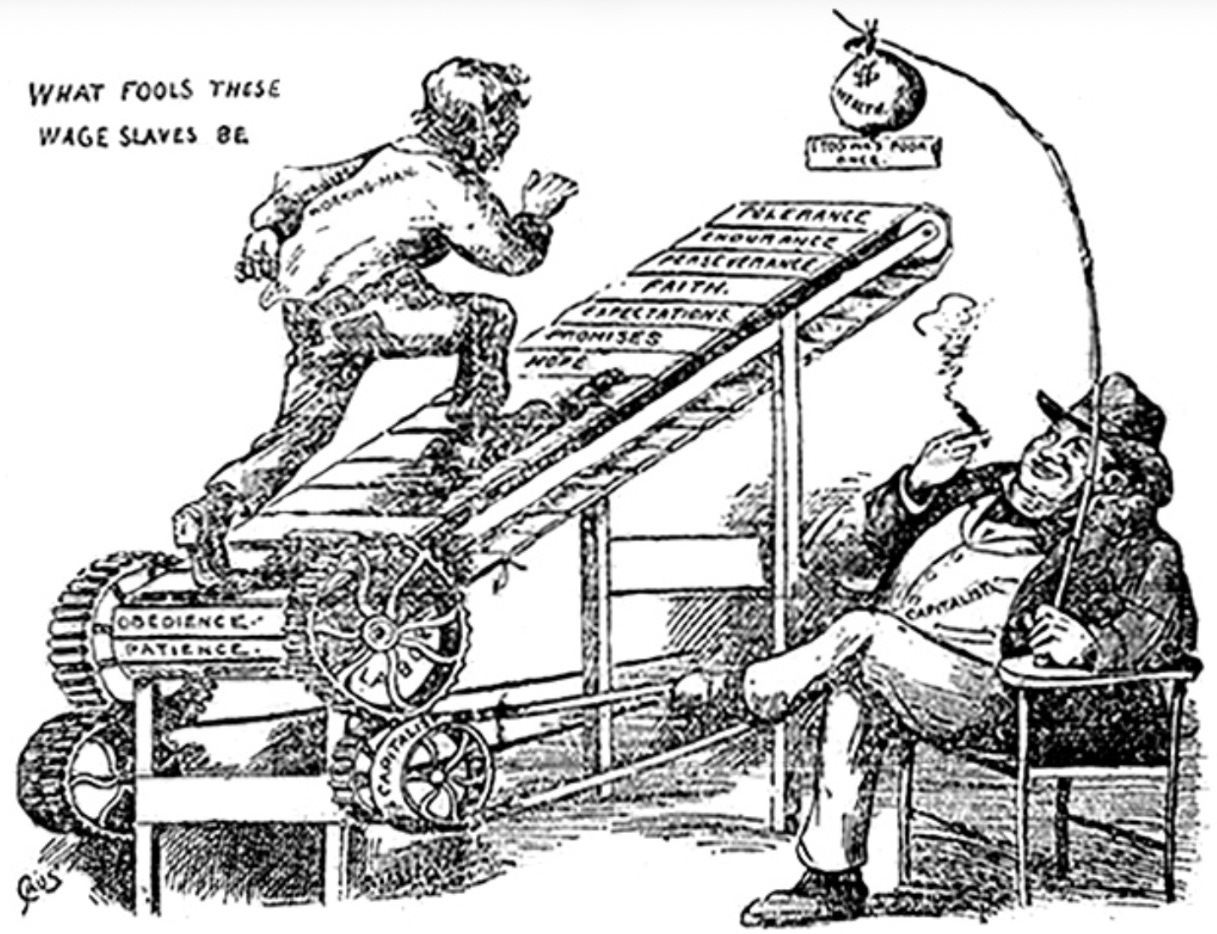
Corporations have spent massive sums of money to convince workers that unionizing is not in their best interests. (And where did this money come from? That’s right, from the value created by workers.) Despite what you may have been told, a union is one thing and one thing only: It is the workers of a company joining together around their common interests to create the bargaining power necessary for their democratic voices to be heard. That’s it. It’s not an outside force, as workers are so often told. It’s not a drain on worker pay, as all the hoopla about “dues” suggests.
Corporations hire consultants, people who have spent years studying how to turn workers against the idea of unionizing, using psychological scripts to undercut worker solidarity. They bring in union busters, people whose sole role is to bully, intimidate, and frighten those potentially open to unionizing. They try to get employees to turn worm, siding with employer interests. In the unlikely event of a strike (contrary to popular belief most unions never go on strike), they bring in scab workers to negate worker bargaining power.
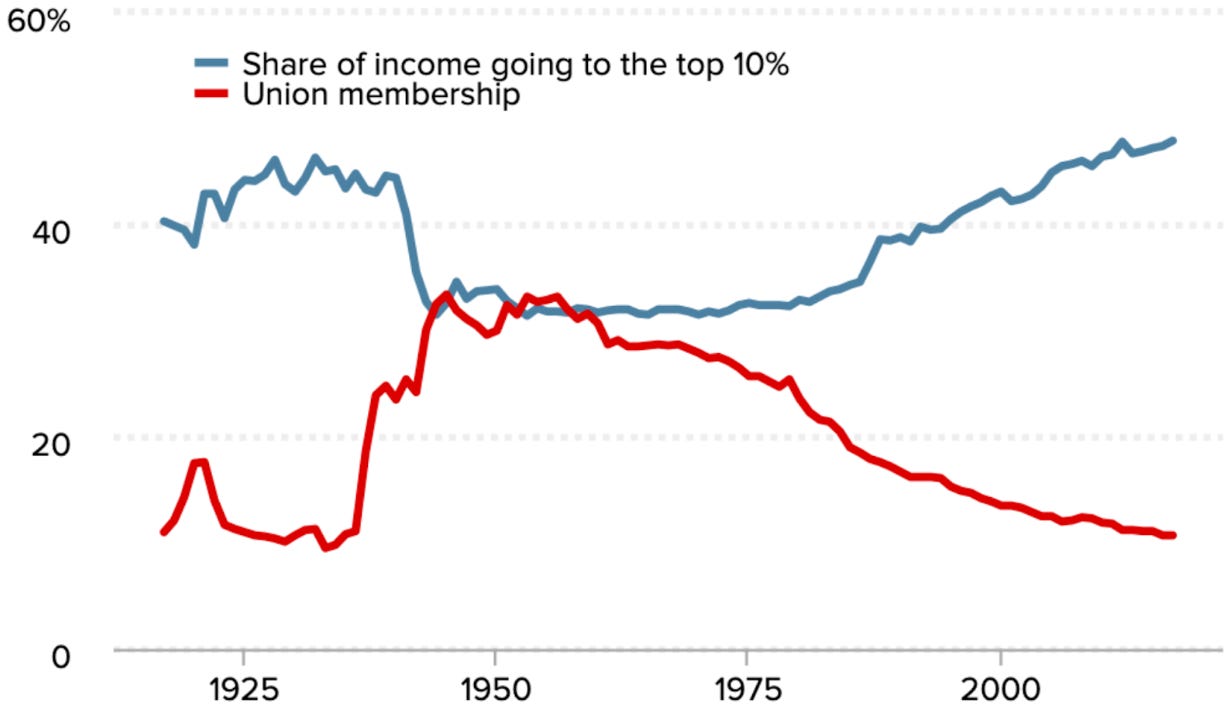
Their efforts have largely been successful, too. Just look at the results. The reality is that union participation is highly related to income equality. There is a very strong negative correlation between union participation rates and the share of total income siphoned off by wealthy elites. When union participation rates exceeded 30 to 40%, the American dream was alive and well. As union participation has plummeted from 30+% to today’s meager 10%, income inequality has skyrocketed (graph from Jacobin).
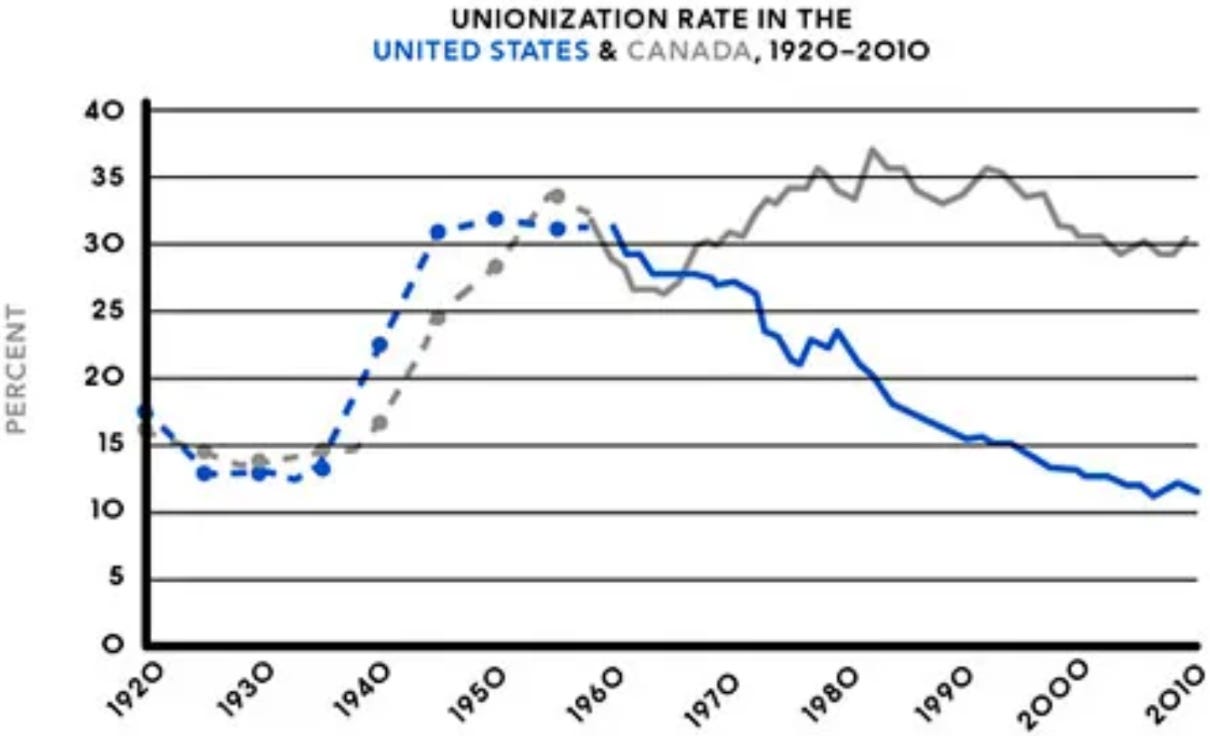
Income inequality in Canada has escalated far less than in the United States, in part because the labor movement was not eradicated there. Canada’s union participation rate today remains above 30%, as it was in the late 1940s, despite a dip in the 1960s (graph from Mother Jones). This should make for a pretty compelling case for unions. Trump supporters seem to believe the erosion of the “American dream” is largely due to cultural issues, not labor issues. What they are frustrated about is very real. They are, however, misattributing the cause.
As reported in the February 2026 edition of Labor Notes, American workers now take home the smallest piece of the economic pie on record. Though corporate profits are reaching record highs, the proportion of economic output going to U.S. workers has fallen to a mere 53.8%, almost half. Let that sink in. The workers that keep the country running, that produce our GDP, are paid only half of the value they generate, even though they make up the majority of the population.
The sad reality is that workers do have the power to improve their conditions. The ruling class would of course prefer us to think that marches, posting on social media, and voting harder is how citizens are supposed to effect change—as though we need only raise issues and they’ll respond from the goodness of their hearts. Only it’s a fiction. As Joseph Luders outlines in his excellent “The Economics of Movement Success”, the reality is that social change typically only occurs when the cost of disruption becomes more painful than the cost of concession.
Organizing enables workers to compel the changes they want made to their economic lives. This requires solidarity. Divided they are powerless. Organizing must, therefore, build on latent class consciousness and increase understanding of the larger economic power structure. Above all, it must unite workers where there is common cause and effectively sideline division about the rest. Whether you unionize or not there are still ways to organize and influence in the workplace. (See my series on influence mapping. More is to come.)
To close, for now, power is actually on the side of the masses, but only where and when they can make their numbers felt. Only then can you use the structure tests necessary to know when action will truly be effective. Remember, democracy is power, which is why employers want to keep it out of the workplace. If you want your democratic voice to be heard, you have to demand it. You have to take action. You have to organize.