
Narrative Warfare

The Lateral Lens is a reader supported blog. If you enjoy the content, please consider becoming a paid subscriber. My family thanks you.
Narrative Warfare
Stories contain frames. Frames contextualize interpretation. A frame shared by enough people is invisible. It becomes “just the way things are”, the background against which the figure emerges in contrast. Just because a frame is unnoticed doesn’t mean it’s not there. This concealment amplifies its power. It makes for a system you participate in without being aware. Your very participation then helps reify and reproduce the system of which you are a part.
“It’s all stories,” Terry Pratchett once said. “Change the story, change the world.” We can take this further. Your very sense of self is in part a narrative structure composed of accumulated beliefs, stories, and assumptions shaped by your social development. These together frame your values, reactions, and interpretations, guiding—or constraining—your very ability to sensemake, to make what you feel to be “understanding”. This narrative matrix, your very sense of self, is a constant site of struggle.
You are a political subject. As such you are a nonstop target (and product) of propaganda. Propaganda is not the same thing as disinformation. When Russia said the US manufactured the AIDS virus, that was disinformation. When you watch or read the news, or take a history class, that is often more propaganda than disinformation. Here the aim is less about getting you to believe certain claims and more about reinforcing particular lenses. The aim is to influence how you interpret and react to any claims in general.
Military theorist Ajit Maan calls this implanting of frames “narrative warfare”. To control how you “narratize” is to influence the meaning you assign to information. Alexander Dugin, a.k.a., “Putin’s Rasputin”, refers to this as “noomakhia” (war of the nous), a reworking of the noosphere. In the East, Vladimir Vernadsky popularized the concept of a biosphere, adding to it a layer of thought and meaning. In this model, the geosphere is the formation of the earth, the biosphere the formation of life on earth (which in turn alters the geosphere), and the noosphere the emergence of cognition (which in turn alters the biosphere).
In the West, Jesuit philosopher Teilhard de Chardin likewise popularized the idea of a noosphere as a type of emergent world mind. With his “noomakhia”, Dugin developed de Chardin’s process theology into a collection of warring hive minds strategically struggling for hegemony, for cultural control. This is not to say such “fifth-generation warfare” exists somehow because of these thinkers and ideas. Noopolitik has always been with us. These concepts simply give us a vocabulary to recognize and verbalize this reality.
Narrative and ideological warfare by definition encompass the noosphere. In this arena there is no such thing as “peace”. There are, rather, people who are more or less self-aware and upfront about what they are doing. US leaders, for instance, constantly assert that only their enemies engage in propaganda while they just forthrightly stand for “freedom and democracy”. Liberalism must, after all, maintain its core assumptions, which are increasingly becoming an unconvincing façade.
Classic liberalism assumes you are an a priori individual, born a blank slate. You are, as such, your very own separate reality that freely chooses the beliefs and actions that then lead to your own poverty or prosperity. Marxian psychological theory maintains this is incorrect. Who you are includes a social, cultural, and material context. Stated another way, the smallest divisible human unit is two, not one—one is a fiction. In this philosophical rift we see why anthropology and psychoanalysis tends to be on the side of the Marxists. Politics aside, their core psychological assumptions are simply more correct.
Yet you can’t actually set politics aside. Each of these philosophical stances, and, further, each of these empirical psychological claims, cannot be decoupled from their massive political implications. Borrowing a phrase from Wittgenstein, as far as one can dig, until you hit bedrock and your spade turns, it is in fact politics all the way down. This echoes Žižek, in Christian Atheism: All philosophy, in the end, is political. Religion and theology are philosophy. American Christians tend to assume (or pretend) that their politics are a subset of their theology. This is backwards.
A society’s religion is an ideological superstructure overlaying a material base. It can either serve to justify and maintain the base or challenge it. Seen through this lens it makes sense why Rome would appropriate Christianity and turn it into an imperial religion. It makes sense why Western Christianity would spin off such cultural artifacts as televangelists and the reinterpretive “prosperity gospel”, despite however oxymoronic it might be.
Every gospel we have, after all, depicts a Christ siding with the poor and downtrodden while pointing out the antisocial sins of wealth hoarders. To even join the original church one had to agree to live communally, with no wealth inequality. This is also reflected in the early church fathers, such as St. Basil, who insisted that when the rich give to the poor it is not “charity”—they are simply returning to the poor what is already rightfully theirs, a sentiment that is also found in Islam.
How then can one maintain that religion supersedes politics? Whether you politically side more with St. Basil the Great or Paula White, it should be obvious that religion is also a site of political struggle. It is not a bastion. All religions reproduce within them the larger political struggles in society at large, and here they also tend to become confined to what the culture deems to be “acceptable” positions, such as being slightly to the right or left of a culturally manufactured “center”.
Pick a team, Eagles or Chiefs, root for them, identify with them, but keep watching the same ESPN. Never mind this is a system run by people who control both “sides”, who are willing to rob future generations, transfer ever-increasing sums of money from workers to themselves, and wreck the ecosystems in which we all live to satisfy their donors and further enrich themselves. Both “sides” are equally culpable. We here forget the obvious: Right vs. left is relative. Liberals are to the left of…what precisely? If you are only “left” of what is now a far-right center, then you’re in the same camp. You’re just sitting on the other side of the fire.
There is again growing recognition that capitalism is holding back the productive forces of society from improving the lives of the greatest number of people possible. It relies on scarcity, even if manufactured. It is a massive Ponzi scheme that maximizes extraction until it cyclically runs itself into an inevitable “crisis”. When it then comes time to choose between updating our economic system vs. sliding into reactionary fascism to protect the wealth of the owner class, at the end of the day, which side do Western liberals always choose?
We live in a revisionist society that uses “capitalism” as a floating signifier for all that is good while the boogeyman of “Marxism” provides a catch-all basin for everything that challenges the supremacy of capital. Quite ironically, Marx saw capitalism as a necessary good—he just recognized that societies eventually outgrow its utility. And most amusingly, while we now hold up Adam Smith as somehow being a founding father of our economic system, he was actually far more critical of capitalism than Marx. But the truth doesn’t matter. It’s narrative warfare, remember?
It’s brilliant in a way. The greatest trick capital ever pulled was convincing us that liberals are in fact leftists, leaving us in a bizarro world where two entirely neoliberal and staunchly pro-capitalist parties, each equally controlled by the owner-donor class, now sit around and meaninglessly accuse each other of being “communist”. As the saying goes, left wing, right wing—same bird. This is of course by design.
As outlined by Rinku Sen, the neoliberal establishment spent decades strategizing, researching, and workshopping what non-economic cultural issues they could get us to fight about to keep people distracted from demanding actual change to the relations of production. How else could they get workers to abandon solidarity and turn on themselves? You know the answer: Focus on anything but class. Focus on race, sexuality, religion, on any rotating, feared “other” except class. Focus on identity politics (which can be commodified!). Focus on anything that spotlights horizontal differences and not vertical ones.
Consider, if I can control the bounds of discourse you are willing to entertain, then I control you. By consenting to engage in an argument I want you to engage in, you thereby accept its larger frame. By keeping the “Overton Window” of acceptable discourse firmly within this desired frame, I can then keep you from ever straying into another. That is our “two-party system” in a nutshell. It’s an elaborate game of good cop/bad cop. The two cops, however, are partners, and ultimately want the same thing. They want your obedience and continued participation. You just get to vote on the tactics they use.
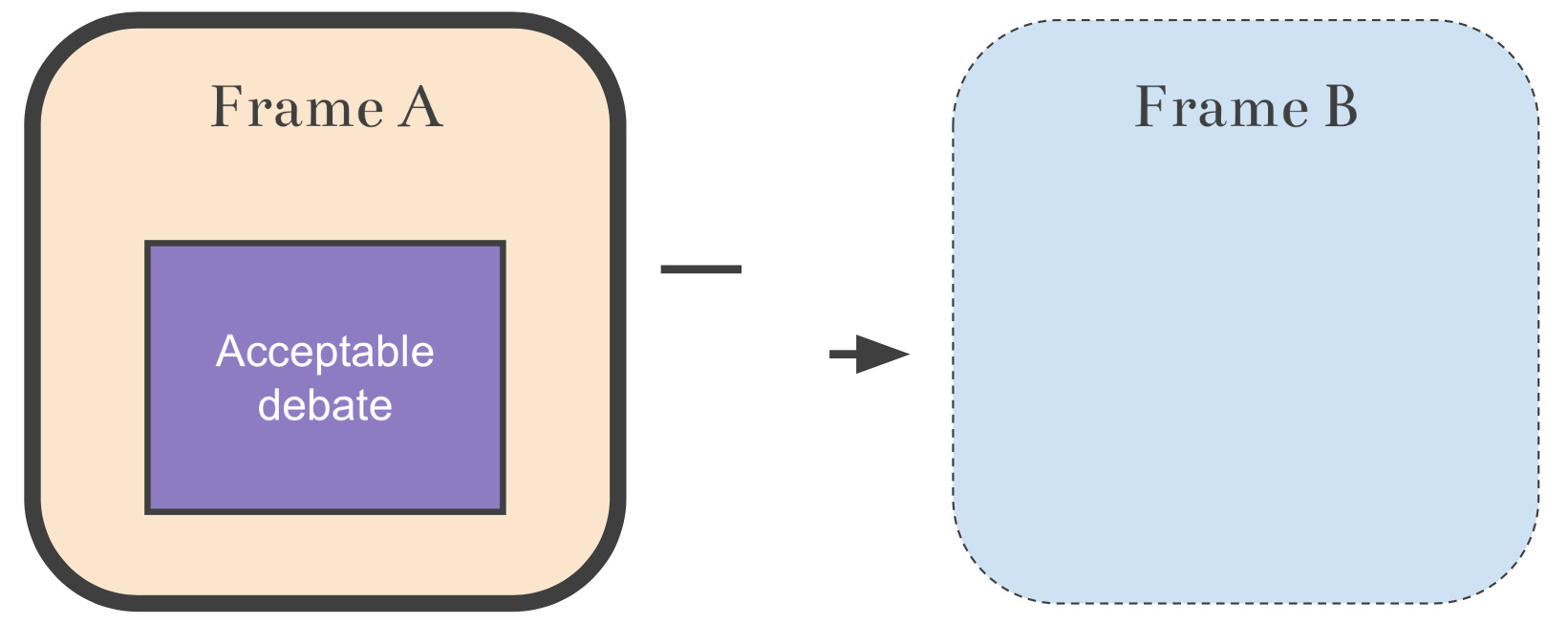
The reality is that as long as we consent to arguing over the branding of the same neoliberal system, we are its captive. This is true no matter how much propaganda about “democracy” we ingest. It’s a double bind: If you don’t want the clownish, petulant label of reactionary fascism, then you’d better vote for the more sophisticated and morally-superior option, positioned for the discriminating voter, for the voter who wants to be seen as above it all. You can then enjoy what Ryan Engley describes as true cynicism: What the cynic secretly wants is to keep playing the role of the cynic, which means they don’t truly want things to change.
As described in Catherine Liu’s excellent Virtue Hoarders, it is becoming increasingly clear that what brunch liberals want is to continue enjoying their petty bourgeois privilege while simultaneously feeling morally superior to everyone else. In other words, they want to be “doubly privileged”. Thus, in 2016 we saw the well-to-do and highly-educated virtue signaling their “leftism” by inanely declaring “I’m with her”, expressing support for the monster that is Hillary Clinton. As Liu outlines, this encapsulates why liberals are now equally hated by both conservatives and real leftists alike: Modern liberalism is a politics perfectly suited for social media—it is purely performative.
While it is the practice du jour to blame conservatives for everything, Liu spotlights it is more the liberals holding up our corrupt system. They are the “good cop” capturing revolutionary energy and reengaging it in service of the owner class. Conservatives at least recognize our system has fundamentally failed workers. Their hatred of what Liu calls the “Professional Managerial Class” is not misplaced—we do in fact need a more worker-oriented economy. Where they derail themselves is in assigning blame to cultural issues and not economic ones.
A reactionary-fascist return to 1950s cultural values will not bring back the heyday of 1950s middle-class jobs. Such jobs largely only existed as they did because of leftist labor organizing, mass strikes, literal street fighting, and resulting New Deal worker protections, made largely as a concession to stave off greater demands for change. They are not wrong that ivory tower elitists will not save us, but they also do not recognize how neoliberal elitists tricked workers into turning on each other.
It is sad, but in many ways John Carpenter’s They Live is the defining film of our times. Like the hapless citizens in the movie, most of us don’t have the special sunglasses that allow Roddy Piper’s Nada to see what is going on. The sunglasses here represent critical consciousness, or conscientização, a concept developed by Brazilian philosopher Paulo Freire in his Pedagogy of the Oppressed. In the film, the sunglasses “open” a worker’s eyes, allowing him to join the resistance, which he had heard about from a blind priest, from someone who could not “see” the consumer culture that brainwashes us.
The sunglasses are there only if you’re willing to do the work. You cannot seriously entertain thoughts you do not have a sufficient conceptual vocabulary for. You cannot challenge a frame without recognizing its presence, who it serves, and what it’s doing. And this is often uncomfortable. When someone challenges an important belief you will typically feel threatened and attacked. You feel this way because your very sense of self is not something separate from these beliefs. As you take on a view, it grounds your sense of self in relation to it. The contradicting of this view is felt as a threat to self. You feel threatened in a very literal sense. The emotional response is real.
There are no human stories without the lens of self, without the projection of subjective agents with their own presumed inner workings. In other words, there is no such thing as a bird’s-eye view. Perspective is always situated. Interpretation requires an interpreter. The making of “sense” requires narrative, just as value judgments require values. This should not be confused with being somehow “anti-science”. Science works in that the degree of belief in empirical claims should be based on the degree of support provided by diverse, replicable evidence.
However robust an empirical claim might be, however, its meaning does not arise from the rubric of empiricism—it is subjectively imparted by the person narratizing the claim. To quote Lacan, yes, the image of what you see is in your eye, but your “I” is also in the image—you are yourself embedded in the representations you create. As Ryan Engley puts it, however you frame something, it is framed from your situated subjectivity. To act like your argument or critique is just an objective representation of “reality” ignores how you are an inseparable part of your argument—else there would be no argument.
Freire’s conscientização stems from critical theory, which originated in the 1930s with thinkers like Horkheimer, Adorno, and Marcuse. Unlike critical thinking, which embodies an Enlightenment, liberal, and presumably “apolitical” lens in assessing the soundness of claims, critical theory places the spotlight on a thing’s situated politicalness and how this shapes the lenses used to derive meaning. Critical theory, in a nutshell, is about countering narrative warfare. It’s about equipping the thinker with the tools necessary to expose the frames at play and explore useful alternatives.
Philosopher Slavoj Žižek makes this point when discussing history as symbolism. There are no human stories without the lens of self used to impart meaning. The same set of events can be narratized in very different ways. That such-and-such a battle was indeed fought might be a historical fact, but its interpretation, symbolism, and meaning is a fabrication created in the present—and that can always be changed. We, in the now, construct “history” through the lenses we currently inhabit.
In much the same way, a country’s origin story is a mythology. Challenge the mythology and you challenge what a country is about, what it stands for. History, understood in this way, is a tool used to help reproduce a given power dynamic in the present. Understanding the mythology of a people, a nation, or a corporation, cannot be meaningfully done separate from the present power structure such stories are meant to reify, protect, and reproduce.
American exceptionalism was a 20th-century justification for imperialist hegemony, playing off the older genocidal ideology of manifest destiny. Similarly, our modern corporatocracy’s acceleration of wealth inequality relies on a particular interpretation of the American theology of individualism, with today’s “corporate individuals” being the only people that seemingly really matter. From late-stage capitalism’s inevitable lapses into fascism to Big Tech’s increasing authoritarianism and militarism, one cannot understand this madness without critically examining the load-bearing narratives that prop it up.
Instead, we keep focusing on the latest boogeyman and hero, the people who are supposedly “the problem” and the saviors who will allegedly save us, if only we vote harder. This, of course, works in the ruling class’s favor. Anything that perpetuates our fixation on Great Man Theory, keeping us focused on particular personalities and groups. Such thinking is itself the problem. As Catherine Liu highlights, the liberals out there protesting that if only Trump hadn’t won they’d be at brunch right now, they are the problem.
On LinkedIn there are pockets of people seeing through this, but usually only selectively applied to the corporate realm: Stop blaming teams. Stop focusing on puppet CEOs, their cult of personality, and their unethical gaming of the stock market. “It’s the system stupid”, people will say in this context. But then, when it comes to our larger, national system, all of a sudden “Trump” is the problem. You might as well throw in the towel. Our economic system is not broken. It is functioning exactly as intended. Trump is simply our system unmasked, bare faced, and seething with bourgeois narcissism and greed.
Yes, bougie liberals would love a more sophisticated mask placed on our puppet leader. Perhaps if Kamala runs again they can vote for a black, female Trump and collectively return to brunch—but nothing will change. The mass exploitation and accelerated extraction will continue. The genocides in Gaza and Africa will continue. The US policy of nonstop war for corporate profit will continue. (Did you know, of the 249 years that the US has existed, it has been at war for 233 of those years? Let that sink in.)
It’s the system, stupid, and it’s not broken. It’s monstrous by design. We must examine the system itself, its origin story, its mythology. We must dive into it and surface the paradigms that have always been at play. This is the only way to expose their distorting effect on present culture. Moving forward, this is what The Lateral Lens will be about: union organizing, critical theory, and societal change.
This is your heads up. If this disappoints you, then please feel free to unfollow. If this is your jam, then please send this along to anyone you think might benefit.
Again, if you value this work, please consider supporting. Thank you dear reader.