We Can Do Better

1. Blind Language
You may have heard that the only social responsibility a business has is to “increase its own profits”. At least, that’s what the Friedman Doctrine would have us believe. We were promised this doctrine would benefit us, that the value would “trickle down”. Perhaps unsurprisingly the opposite has occurred, and for more than half a century now.
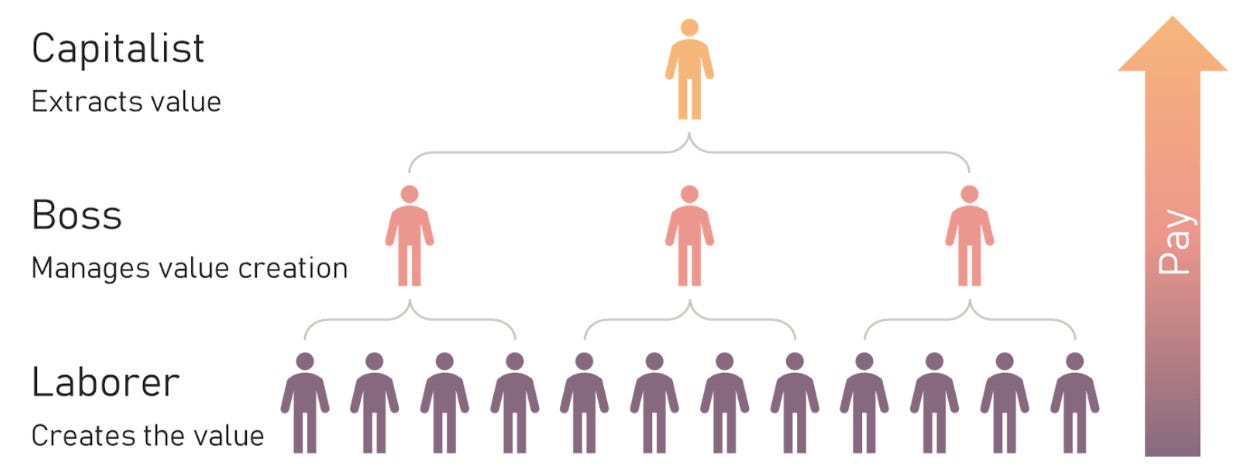
If you think of our system as a pyramid, the value created by the base, the majority, is appropriated by a minority sitting at the top. This is not a controversial statement—
that is what capitalism is. Some of that value is then paid back to workers as wages.
At the top of the pyramid are people with high individual power in a system they control. It should not surprise us then that they would want individualism lauded as a virtue. They’re protecting their own special position by teaching us, the benighted masses, to religiously value a condition in which we have no political power ourselves.
Workers can only democratize their own lives by rejecting this ethos, which is why so much of our education focuses on ensuring this never happens. We are conditioned, by schooling, and from early childhood, to earn a wage, to get that job and car and house, to rack up and pay bills and rack up and pay some more, to raise some kids and teach them to do the same. In short, we are trained to work, to consume, and to generate value for the appropriators.
We now live in a system where the top 1% is seizing more of the economic pie than at any time in history. Things are falling apart. There are too many rents in the fabric. For the base of the pyramid, gone is the comforting illusion that we have a flawed but best of all possible systems. What is left is the dawning realization that we have been lied to. This is not a democracy. It’s a rigged game. We have long lived under a dictatorship of the few and privileged and perpetually out of touch. And this has global ramifications.
Throughout the twentieth century any country that tried to bow out of the extraction game was attacked. Not because of any crime against humanity but because they closed themselves to private capital. This held true across the board. The Russian, Vietnamese, Chinese, Cuban, and Korean revolutions were, to the capitalist class, seen as punishable by death—even if this also meant the death of our own children.
And so our own ruling class fought back in war after war after, losing each and every one while never caring, not so long as they remained at the top of their own predatory food chain. After all, how dare some uncivilized peasants deprive them of their cheap and abundant resources and labor. Of course, conveniently, they don’t see it this way. Of course from their own liberal, elitist perspective, all this was absolutely justified, even “moral”.
Just as the Franciscans rationalized imperialism as sacramental urgency and the Dominicans by way of natural law, modern liberalism does so through the idealist lens of “Reason”. Liberalism is a religion of the bourgeoisie, rejecting historical materialism in favor of Platonic idealism. As Samir Amin observes in The Liberal Virus, the hegemonism of the U.S. is therefore considered not only natural but necessary to save the world itself (while incidentally robbing it blind in the process).
According to their religion’s “science” of economics, financial outcomes are dictated by “markets”, the result of forces akin to abstract laws of nature and not material history, systematic oppression, appropriation, and extraction. The problem with the liberal’s system is that it is largely imaginary: What the ruling class has achieved for itself does not stem from “economics” at all but from never-ending conflicts occurring entirely outside their supposed free market.
The “market” then is not an explanation of actually-existing capitalism and never was; it is a myth preached by way of justification. In the words of Amin, the dominant forces are as they are primarily because they succeed in forcing their language on us. “In order to develop effective strategies, social movements must liberate themselves from these confusions” (p. 16). This truth is echoed in Ghassan Kanafani’s brilliant conception of “blind language”.
The ruled classes are left with a hollow vocabulary that does not correspond to reality. To this end the ruling class has “buried us up to our necks in what might be called ‘incantory thought’ that replaces clarity with sound and disguises the absence of a goal with ringing words…” (Selected Political Writings, p. 73). Granted, the plight of American workers is nothing compared to Gaza, of which he was writing, but Kanafani’s conception of blindness is applicable to all peoples living in a system waging war on their very social consciousness.
In a great many ways American workers are victims of robbery. A revolution was carried out under our noses, one that fundamentally altered the social contract. What can now be clearly identified as the Neoliberal Revolution could quite realistically be called one of the greatest heists in history. We need to wake up to what has happened. As the Marxists put it, we need our consciousness raised. As Christ put it, we need the scales removed from our eyes. To paraphrase Kanafani, we need a language with which we can see.
2. It’s Not You
The Neoliberal Revolution ushered in the aforementioned “Friedman Doctrine”, effectively restructuring what it means to be a corporation. This made austerity the policy of the land and economic precarity increasingly a plain fact of life. Goodbye career man. Hello gig economy.
Under what Robert Reich calls the “industrial statesmen”, American corporations once operated for the benefit of employees and their communities. During the Neoliberal Revolution these leaders were ousted as power was increasingly given over to those seeking to raid the corporate coffers. Waving the banner of the Friedman Doctrine, the corporate raiders preached that the only legitimate purpose of a corporation is to maximize profits, which, conveniently of course, means their profits.
Writing for the Harvard Business Review, William Lazonick notes that prior to this shift earnings were largely reinvested in employees. This created shared value, rising wages, and economic growth for the country. It also made companies more competitive in the long term. To appease the corporate raiders, however, every quarter now must be bigger than the last. The Neoliberal Revolution pivoted the economy from a strategy of “retain and reinvest” to one of “downsize and distribute”, leading to the beginning of today’s absurdist tyranny of efficiency.
In 1982 gas was poured on the dumpster fire. The SEC passed Rule 10b-18, thereby legalizing stock market manipulation through open-market repurchases. Executives could then use stock buybacks to lift their own company’s stock price, helping them hit their targets and secure larger bonuses. From 2003 to 2012 a full 90% of companies in the S&P 500 used more than half of their earnings to purchase their own stock, with another 37% of their earnings being absorbed by dividends. One does not have to be a math genius to see this leaves almost nothing to invest in employees or productive capabilities.
It was then realized that mass layoffs are another way to manipulate the stock price and appease the corporate raiders—and we’ve had nonstop mass layoffs ever since. Yes, the research shows that layoffs trade against the long-term health of a company and the surrounding community. The corporate raiders don’t care. They’re there to raid the community, not help it. Even when they engage in “philanthropy” it is largely as a way to dodge paying taxes.
As an aside, I worked for a large tech company that of course claims it has very legitimate reasons to keep doing layoffs, without ever mentioning these “reasons” were caused by literal decades of executives enriching themselves by manipulating the stock price. Now not only have thousands upon thousands of people in my community lost their jobs but small businesses are now closing shop because they have lost their customer base.
This should all lead us to ask, why is fudging the current quarter’s numbers more important than the long-term health of a company and its community? The answer, which is what executives would rather we not focus on, is that they are simply doing what they are paid to do. This should become a rule of thumb: Whatever top executives are actually incentivized to do, that’s the company’s real mission and vision. Remember, what is incentivized is policy—all else is lip service.
Because of the corporate raiders, American wages have been stagnant for more than half a century as executive compensation has skyrocketed. Since this corporate takeover, the top 1% has transferred an estimated $50 trillion from America’s working class to itself. It is hard to even fathom such a sum. Consider, this is fully half the estimated amount the U.S. economy made in unpaid slave labor in almost 250 years.
Morbidly, many still claim this takeover was “democratic” because, as they put it, “anyone can own stock”. This conveniently ignores that votes are based on shares owned and the richest 10% already own almost 90% of all stocks. This means wherever stock can be purchased by non-employees the already wealthy (or a hedge fund or private equity company) can buy a portion of the votes and turn a corporation into an extraction machine for their own gain.
All this naturally impacts worker wellbeing. As reported in the LA Times, healthy people impacted by a layoff have more than an 80% chance of developing a health condition in the following 15 to 18 months (and often after having also lost their healthcare). Death rates among those impacted by a layoff remain increased by 15-20% for 20 years to come. Suicide rates more than double. Domestic abuse skyrockets. Marriages fall apart. Research on the Life Events Inventory has found that a head of household being laid off is more stressful than going blind.
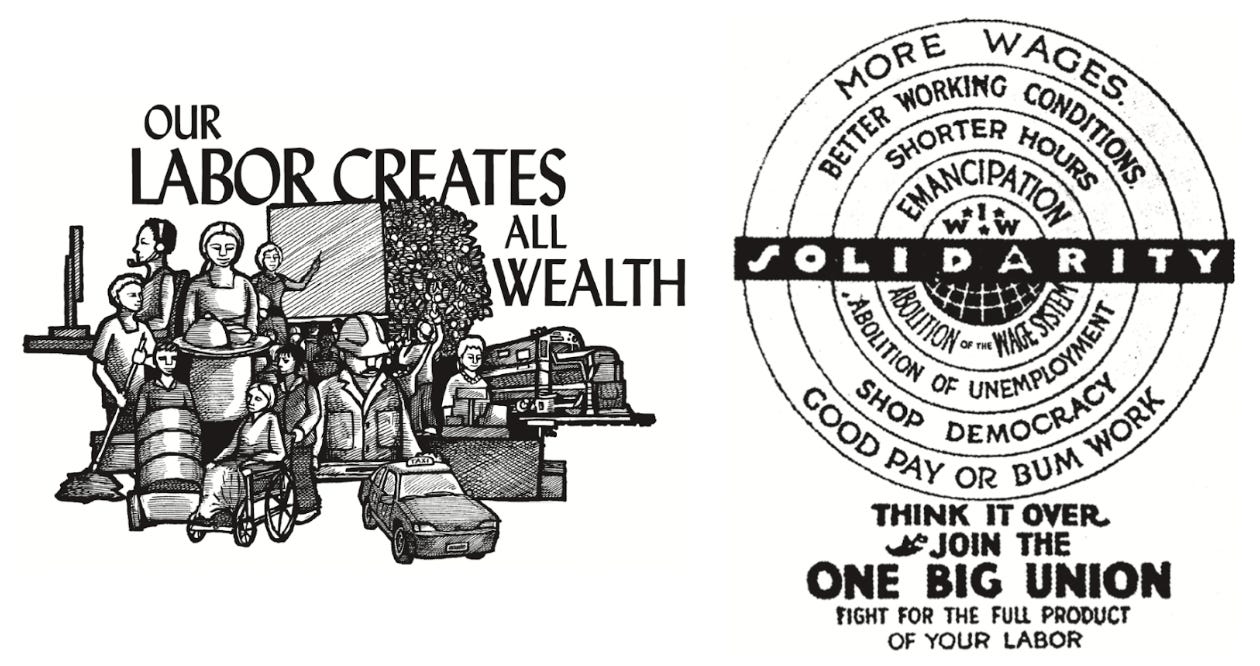
Layoffs destroy families, and for what? The fact is the Neoliberal Revolution decimated labor in the U.S. It is high time labor responds in kind. What is needed is a mass response, a return of militant unionism, akin to the Wobblies of the early 20th century. This is a distinct part of America’s history and heritage that needs to be remembered: The Chicago Idea. One Big Union. Worker solidarity and direct action.
This urgently needs to happen in the tech sector, and before unregulated AI is allowed to disenfranchise workers across the board while our government is asleep at the wheel.
We must stop splitting political hairs and unite. To quote Joe Hill before he was executed via firing squad, “Don’t mourn, organize!” We need direct action and we need it now.
It is only by coming together that workers can again remind the ruling class of a fundamental truth: They only rule as long as we allow it.