
You’re Being Lied To


1. The Wilderness of Mirrors
CIA counterintelligence chief James Jesus Angleton famously described the world of espionage as a “wilderness of mirrors”. Much like John le Carré’s masterpiece, Tinker Tailor Soldier Spy (itself inspired by real events), Angleton was convinced there was a Soviet mole at the top of the CIA. He was taken in by a KGB agent named Anatoliy Golitsyn, who convinced him what the CIA knew about the KGB was largely smoke and mirrors, and that, much as in Tinker Tailor, the Soviets were running rings around Western intelligence agencies.
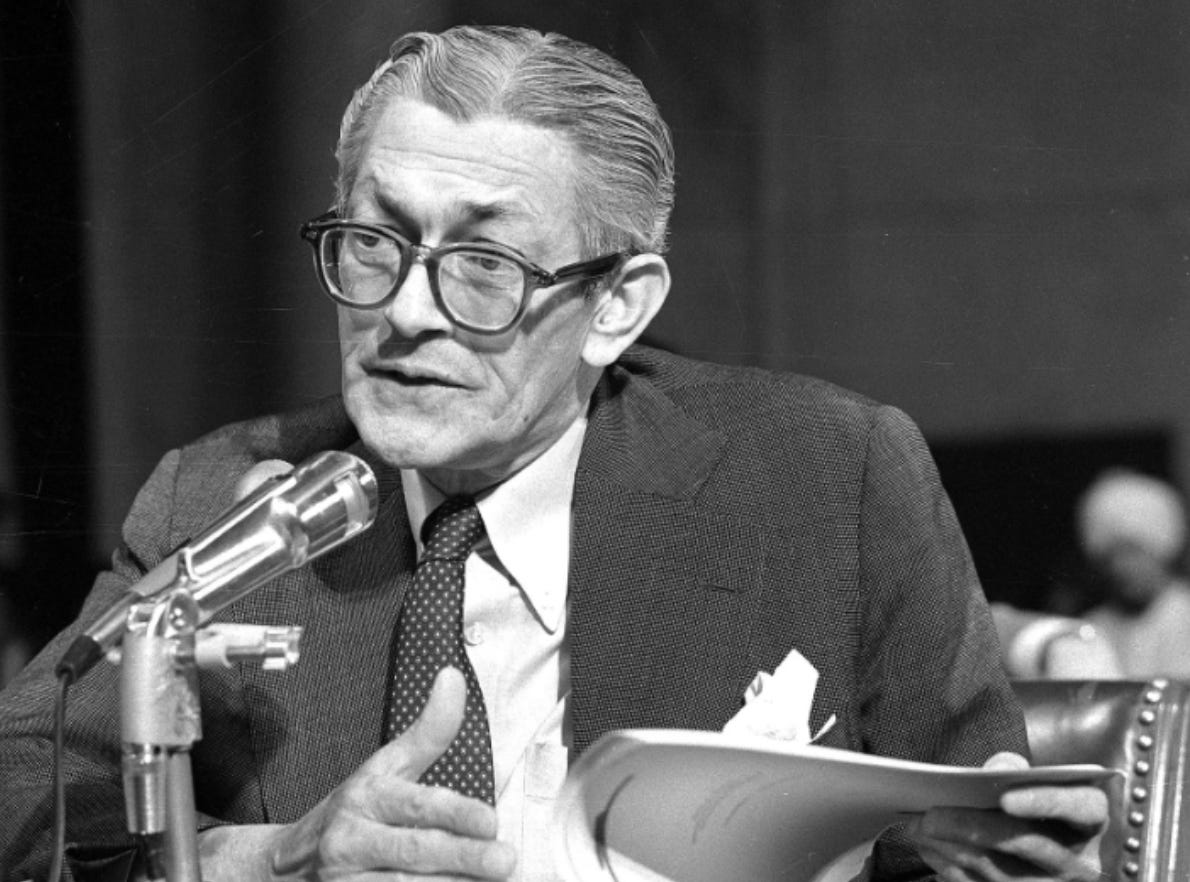
Fascinatingly, there is still controversy over whether Golitsyn was really a defector at all. For us, what is really of interest is the story Golitsyn was feeding him. Golitsyn claimed that Soviet intelligence was a two-tiered structure. On the outer layer was the KGB they wanted the CIA to focus on. On the inner layer was supposedly a behind-the-scenes brain the West knew little about. The irony, of course, is that Golitsyn could have just as easily been talking about America.
Angleton, in all his extreme paranoia, should have perhaps spent less time with his “wilderness of mirrors” and a little more time simply looking in one. As philosopher Gabriel Rockhill points out, this is essentially how our entire political system works. On the outer layer lies the theater of performative politics, the visible “democracy” that is there to hold our attention, to make us feel informed and politically active. This is our Great and Powerful Oz. We are not supposed to talk about what is behind the curtain.
2. Behind the Curtain
The sad truth is that most of us already know what is behind the curtain. We just don’t care anymore. We’ve been trained like seals to focus on other issues. Behind the curtain, of course, is the Wizard, only here it is Big Banks, Big Oil, Big War (which now includes Big Tech), and Big Pharma. You can add to this the commoditized knowledge industry, resulting in what Rockhill calls the military-industrial-academic complex, thereby adding to Eisenhower’s warning to the American public.
As Rockhill puts it, this isn’t about puppeteers pulling strings as much as financiers deciding who gets to be onstage in the first place. If the process of knowledge production is driven by funding mechanisms that serve the interests of empire, then only so much can be said for supposed “academic freedom” (something Lenin observed more than a century ago). Borrowing a concept from James Scott, the two tiers of our system could be called the “public” and “hidden” domains, the former operating like a magician’s flourish.
Here is the public spectacle of democratic elections—practically a religious ritual—hiding the parasite class our system serves regardless of how we vote; there is all the pearl clutching over “affordability”, masking the realities of U.S. austerity and what young people have started to call America’s “kill line”; and of course there is the endless posturing about being the “world’s police” and “protectors of freedom”, running cover for attacking anyone who dares deprive our markets of their resources.
You’re not down with what Western imperialism has planned for your region? Then you’re an enemy of freedom. You want an independent United States of Africa? We will kill you. You stage a revolution and try to kick the capitalists out? We will punish you until kingdom come, decimate your economy, and blame your suffering on attempting socialism. (Just look at Haiti, whose revolution was more than 230 years ago!) You try to point out the evils perpetrated by Western hegemony? You are “brainwashed”. The sad fact, however, is that most Americans are in fact brainwashed, having grown up in the greatest propaganda machine the world has ever known.
We in the West are so immersed in the public dominant narrative that even pointing this stuff out sounds like a conspiracy theory; and, yes, they want you to think it is. Only it’s not. We’re not talking about reptilians and chemtrails here, just trying to focus on the system itself and not individual personalities, which is what our system incessantly tries to keep us focused on. As Rockhill so rightly points out, to dig into a country’s own archives, to delve into what FOIA requests reveal, is not “conspiratorial”, even when what is revealed runs completely counter to a power structure’s preferred narrative.
3. They Choose the Idols
Much of this can be traced back to WWII. Despite what we see in countless movies, the majority of WWII fatalities were confined to Russia and China. The Soviets suffered devastating losses defeating the Nazis and liberating the concentration camps. It is easy to forget that, following this, Stalin was increasingly seen as a global hero and Marxism was fast becoming the predominant political theory of the 20th century. The U.S. propaganda machine stepped in to help “manage” the narrative. Just as the CIA promoted “modern art” as an intellectualist counter to Soviet art (which was meant to appeal to workers), so too did they begin bolstering a “new left”, seeking to steer leftist expression into an acceptable lane.
Simultaneously, the U.S. went about researching and workshopping new ways to turn the working class against itself, effectively destroying the labor identity of blue collar workers. Gone was the violent labor movement of the late nineteenth and early twentieth centuries. Here to stay was the thoroughly bourgeois, morally superior, intellectualist left, the kind of left that, as Stuart Hall observed, would be totally off-putting to actual laborers. Leftism was taken from the streets and moved to the ivory tower, where it was commodified and reduced to professors competing for attention and funding.
As outlined in his book, Who Paid the Pipers of Western Marxism?, Rockhill stresses that if the West wanted Marxism, then the CIA would help make sure it was a variant that was Marxist in theory and ardently anti-communist in practice. Why else would the CIA back and fund people like Herbert Marcuse and the Frankfurt School? Why else would our system laud Epstein’s buddy Noam Chomsky as the epitome of “far leftist” thought? The answer, Rockhill argues, was to replace actionable Marxism with a castrated alternative, what the great Domenico Losurdo dubbed “Western Marxism”.
This is how capitalism survives. It excels at co-opting resistance with theatrical figures like AOC, channeling all that disgruntled energy back into continued participation rather than meaningful revolt. So read Chomsky all you want—all that really matters is that at the end of the day he is anti-communist and will tell you to “vote blue no matter who” (before hanging out with Steve Bannon). Now we have Mamdani as the ascendant face of leftism, rather than a real leftist like, say, Ibrahim Traoré. Yes, we can have all the leftist idols we want, so long as they have the imprimatur of the state.
The real genius here is the double-whammy of then calling these state-approved figures “communists” while dismissing actual leftists as “terrorists”. And it makes sense—the U.S. would much rather we view “leftism” as women wearing pink hats or capitalist politicians holding up little signs in a speech rather than, say, the Black Panthers or the Bolivarians. Better we view the Israel-supporting Bernies of the world as leftists and not the Fred Hamptons. Better we call a protest in Minneapolis a “mass strike” than learn how to organize a real one.
This also works in retrospect, by recasting someone’s image and using it as an idol after the fact. We today celebrate MLK Jr.—yes, he had a dream, but everything else he said is now ignored. Apparently the U.S. only has use for him now that he is dead. The real MLK was an ardent socialist agitator advocating for universal job guarantees and the end of capitalism. While alive, the FBI surveilled him, harassed him, and tried to get him to kill himself. He was also widely hated in America, and at the time of his assassination had a 75% disapproval rating.
The same can be said of Nelson Mandela. If we really always loved him so much, then why, once released from prison, did he rush to thank Castro for Cuba’s Soviet-backed sacrifice in fighting their U.S.-backed oppressors? No, we love only a highly-censored version, omitting the anti-capitalist aspects of his struggles for freedom. We can similarly make movies about the Irish Republican Army fighting against English oppression, but only if we omit the anti-capitalism and avoid pointing out their striking similarities to Gaza, where the U.S. is now backing and arming a Nazi-esque genocide.
We even do this with religion. When America was more labor oriented one was likely to hear Christians arguing that the teachings of Christ, honestly applied, would lead to something like socialism. Today, in an America more consumed by reactionary nationalism (a.k.a., actual fascism), one is far more likely to hear the opposite, which is ironic in that the Jesus was in no way a reactionary figure. What began as a movement where you had to give your wealth away and agree to live in communion (communally, communistically), went on to become such a social force that the Roman Empire co-opted it and turned it into an imperial religion. And it worked, as perhaps best reflected in a quip once made by Bishop N.T. Wright: “Everywhere Paul (the apostle) went there were riots—everywhere I go they serve tea.”
America is now doing something similar. Gone is the Christianity of Eugene Debs and MLK Jr. What began as a movement about liberating the poor has today mutated into a political tool used to keep them in their place. Say what you will about whether Christ would have supported capitalism and imperialism—I submit that the same Jesus who overturned the tables of the money changers would not have supported the land enclosures that forced capitalism on masses of now homeless serf and peasant families. He would have been firmly on the side of the serfs, which should be obvious, and which should have equally obvious implications on what his views would be today.
4. 100 Million Dead
History is never neutral. It is inevitably weaponized. Thus, the “twin evils” propaganda machine was born and Stalin was quickly recast as Hitler’s equivalent, even though the CIA’s own internal documents show they did not find this at all to be the case. Yes, he did horrible things, as did Churchill and Truman, but the fact remains that the number of deaths supposedly caused by Sino-Soviet communism has always been greatly exaggerated. A careful reading of the notorious “Black Book” (the actual source of the famous “100 million dead” figure) reveals that many of these deaths were deliberately misattributed.
In the case of Maoist China, many of the deaths were due to already existing mass famine, ultimately caused by the West’s long suppression of their economy. The reality is that the revolution allowed China to emerge from its “century of humiliation” and lift more people out of poverty than any country in history. When this project began, starvation was so widespread that it was normal to see bodies lying on the street and floating in the river. The average life expectancy was about 30. Fast forward a few decades after the revolution and the picture is quite different.
Despite asinine Western propaganda about “coffin apartments” and so forth, home ownership rates in China are now greater than 90%, and if you lose your job you keep your house. There is a stark contrast in priorities here, as noted by Professor Ali Kadri. In China, wage increases tend to exceed increases in productivity, showing that the value created by productivity and technology gains flow mainly to the people. In China, wages have tended to triple every decade, whereas in the U.S., despite productivity skyrocketing, wages have remained flat for half a century as the richest 1% have transferred $80 TRILLION to themselves from the working class.
In the case of Russia, there is a problem with the very logic being used. If the people rise up and overthrow their capitalist government and then replace existing judges with local tribunals, the capitalist world will call everything those tribunals do “terrorism”, but to them they are the legitimate legal body of the new government. The capitalists will fight back tooth and nail before yielding power. If you don’t resist, then your revolution will quickly come to an end. It’s quite humorous that we call the Bolsheviks “bloody” while ignoring they were simultaneously attacked by 11 countries following their seizure of power.
No, if you successfully kick the capitalists out of your house, they do not clean the place up for you and wish you luck. Instead they trash the place, remove everything of value, and then wage nonstop economic war from a fancier house down the street. As Castro once quipped, when you defeat the capitalists they don’t leave you with heaven—they make sure you start in hell. Perhaps, then, anything the poor do to take power is “bloodshed”, while anything the rich do to keep it is “just”.
The most glaring error in all of this, however, is that the West loves to throw around the “100 million dead” figure without ever asking what should be the most obvious question: How many people has capitalism killed? Should it really matter that most of the U.S.’s atrocities are now committed overseas, in poorer countries? After all, by the very same reasoning employed by the Black Book, the imperial West has easily killed at least 10x this number of people, with Europe outdoing the entire communist world in India alone, then again in the Americas, and very likely a third time in Africa.
Never even discussed is the fact that, again by the very same reasoning, our current system of global neoliberalism kills this many people each and every decade. Anyone who thinks such atrocities are a thing of the past should certainly read Cobalt Red, an eye-opening work outlining one of several ways the West has collaborated to keep slavery alive and well.
4. Labor Erased
In every such case, the purpose of the public narrative is to clear the way for and reinforce the underlying power structure at play. Every culture spins off superstructural mythologies, histories, institutions, practices, and religions to justify and buttress the economic system at play. This is the Marxian concept of base and superstructure. Capitalism survives by absorbing, like the Borg, everything it comes into contact with and recreating it in a bastardized, capital-friendly instantiation of itself.
Keeping this in mind, it is important to stress that our system is not “broken”—it is working exactly as intended. Sure, it’s not sustainable and for most of us things have been getting worse for many years, but it benefits those in power to keep it this way. This is what the Marxists meant by calling our system a “dictatorship of the bourgeoisie”. If we were a democracy in any meaningful sense of the term, then voters could demand the economy be more about servicing society as a whole; i.e., voters could insist that our economy also be democratic. But are we a democracy?
When workers want collective bargaining privileges in an attempt to make the workplace more democratic, is this celebrated as Americans adhering to our core values? No. Far from it. Historically this is met with outright militaristic violence. Our government has been very clear on this: Corporations, come what may, will continue operating as dictatorships. Now, liberals, who, if we’re really honest are the main pillar holding all this nonsense up, would love to argue they are somehow “prolabor”—just look at FDR and the New Deal, they invariably say. Only this is revisionist history.
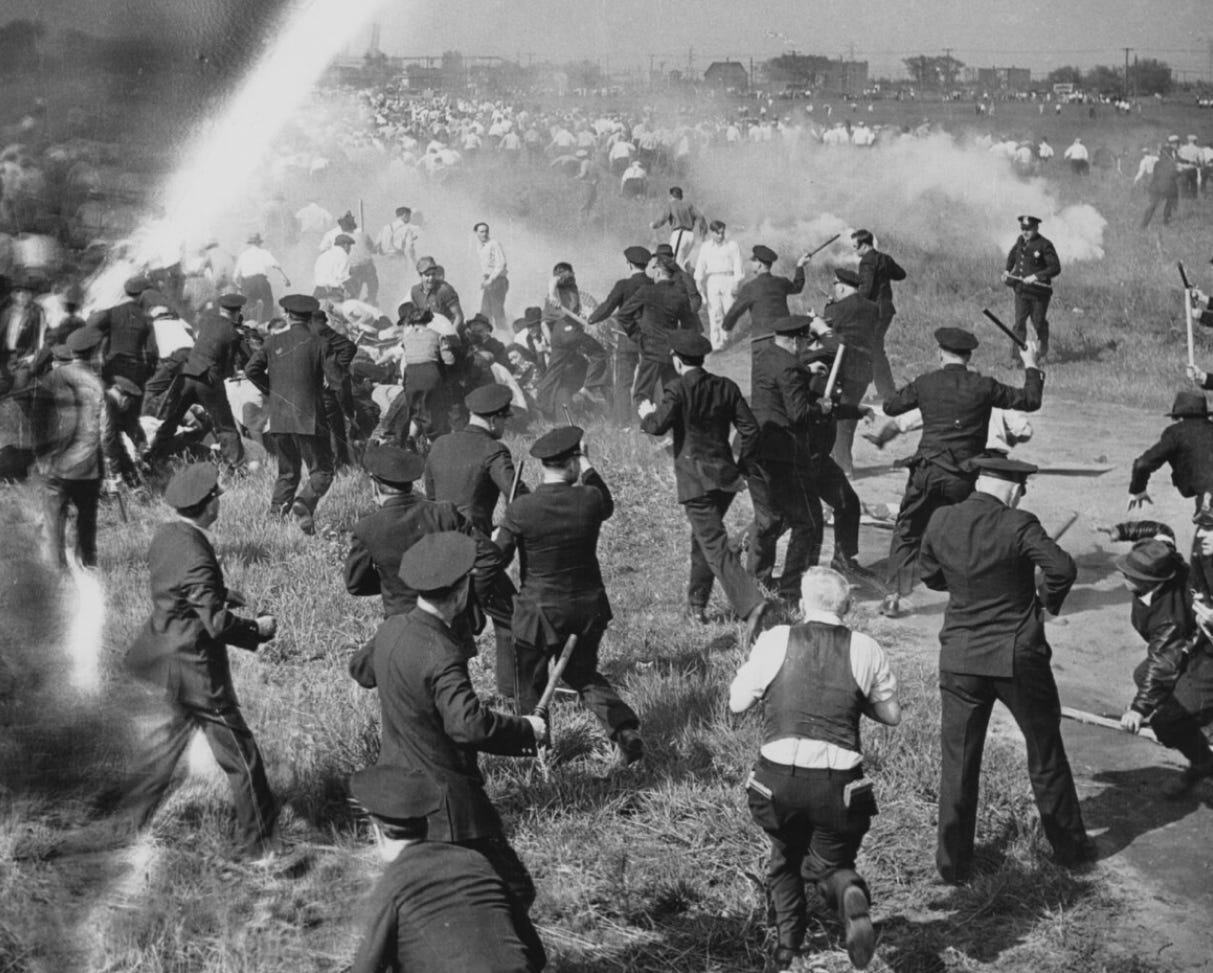
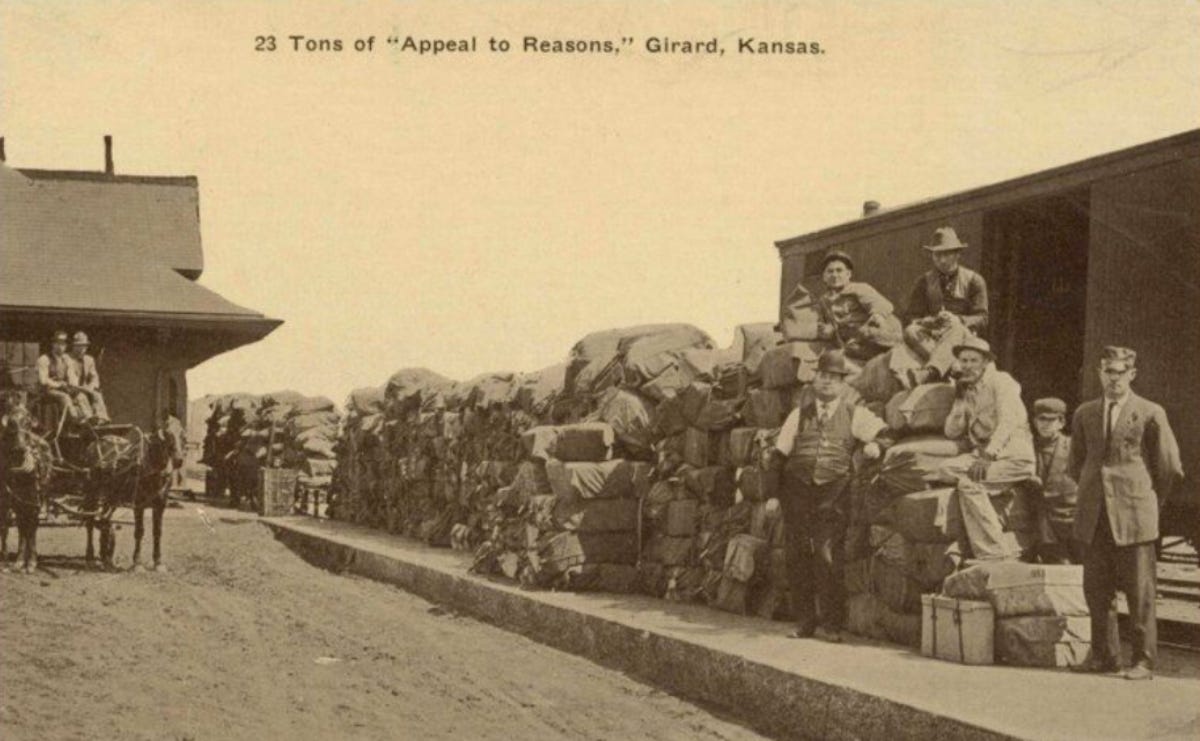
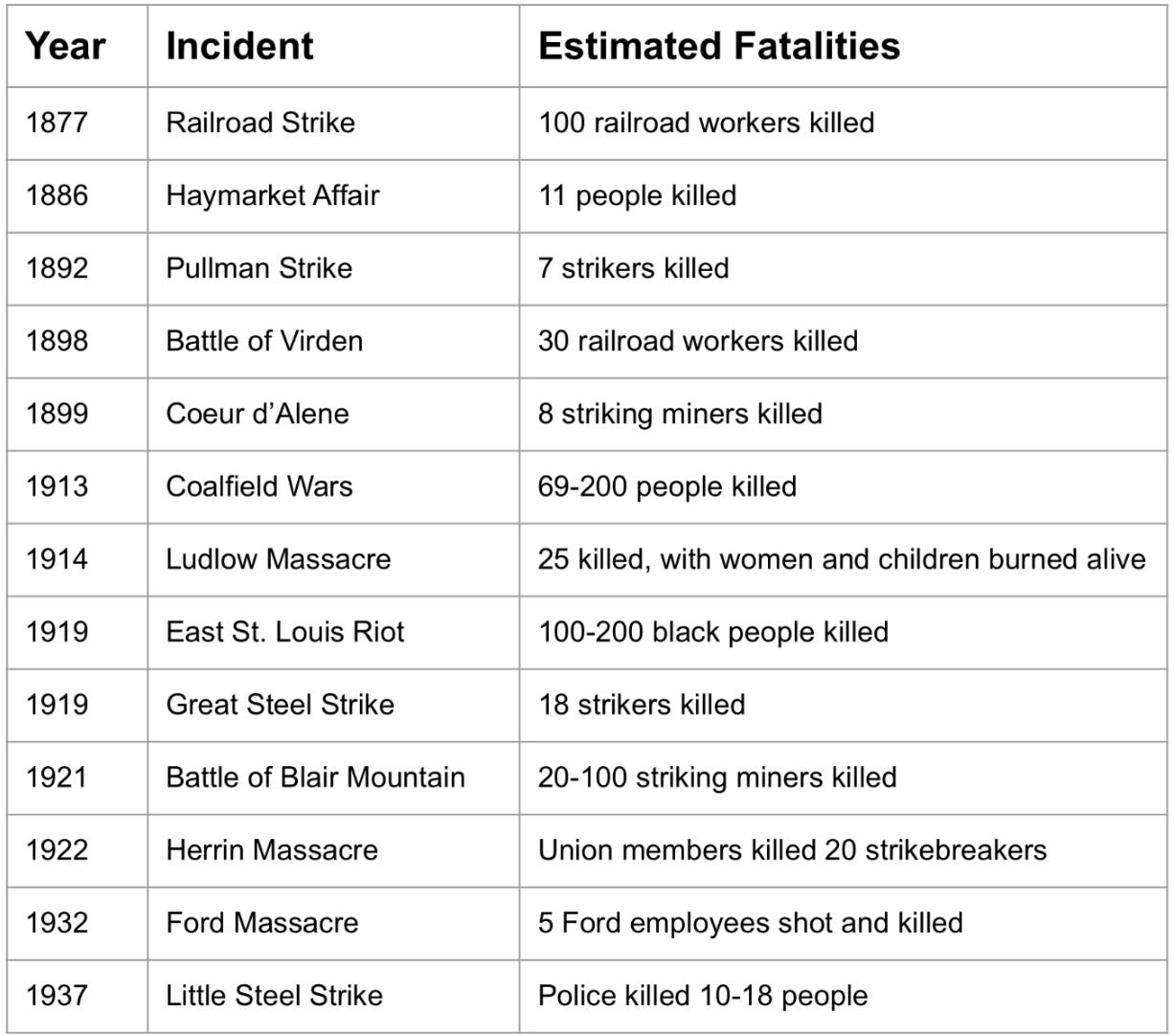
We are talking about a time when actual fighting in the streets over labor disputes was common, when the most popular political paper in America was the Appeal to Reason, a socialist paper published in little Girard, Kansas. (This is the paper that commissioned Sinclair’s The Jungle.) This was a time when the Teamsters were out there acting like the IRA, bombing vehicles and houses, when increasingly popular strikes would shut down entire cities and the military would be sent in to replace strikers with scab workers, often resulting in mass fatalities.
This was a time when America was facing an all-out communist revolution on one side and a plot by businessmen fascists to overthrow the government on the other. The New Deal was an expedient, a compromise to quell the masses. No such tumult, no New Deal. Once the pro-labor element of the population was effectively turned against itself, focusing instead largely on “culture” and “identity” issues (both of which can be commodified), many of these gains were quickly removed. Unions were kneecapped. States passed “right to work” laws, effectively removing most worker rights.
We today celebrate a bizarre, capitalist revision of Labor Day focusing on shopping and sales while ignoring its origins as an attempt to mend relations following the notorious Pullman Strike. We similarly now use it to distract from May Day, which followed the Haymarket Affair and the fight for the 8-hour workday in the 1880s. By neglecting this history we collectively ignore the violent rebellions that won us the minimum wage, child labor laws, the weekend, health and retirement benefits, the list goes on.
Our system, seen in this light, is a con game where the appropriating class keeps workers, the actual producers of value, fighting over table scraps as it accumulates more and more of the globe’s total wealth. Call it corporatism, neoliberalism, imperialism, capitalism, it doesn’t matter. Whatever “it” is, you’re being lied to about it, while its greatest fear—various forms of worker control of the economy—whether you call this socialism, Marxism, or just plain fairness, well, you’re being lied to about it too.
Capitalist cheerleaders love to describe Marxism as a global conspiracy, which is yet another case of accusing the enemy of what you are guilty of. Capitalist imperialism is in fact a global project and, as such, any effective resistance will likewise need to be global in nature. As Kwame Ture noted, the people most strongly opposed to Marxism tend to know the least about it, while with capitalism the reverse is true: Its more ardent supporters tend to know the least about its actual history, what it is, and what it’s doing. Neoliberalism is a global pyramid scheme. In order for the appropriating parasite class to keep getting richer, they must continually ratchet up the extraction of value from workers, families, and the environment.
Another thing we are constantly lied to about is the myth that capitalism drives innovation. It doesn’t. Competition drives innovation, and competition doesn’t have anything to do with capitalism. One could have competition with socialism and one could not have competition but still have capitalism (monopolies anyone?). What makes a system “capitalist” is whether there is an appropriating (capitalist) class that syphons off a great deal of the value created, whether fueled by competition or not. Capitalism actually perverts competition in precisely the same way our incestuous funding mechanisms pervert our research industry.
For the rich to keep getting richer, extraction must always increase. This is taking its toll on families with the nonstop layoffs, on our fellow humans as we’ve offshored much of the suffering created by resource extraction, and the planet itself, which is being driven toward climate catastrophe. Here too our focus on ever-increasing wealth accumulation is guiding tech into nonproductive ruts. As Adam Becker notes in his excellent book, More Everything Forever, we can’t actually colonize Mars—and scientists know this—so why then is there so much nonstop talk about doing so? The answer, perhaps unsurprisingly, is that all the hoopla around it is making rich people richer (as with AI).
Consider, Becker notes, how much easier it would be to fix climate change than it would be to colonize Mars, and yet none of our billionaires are out there salivating to fix climate change. Why? The answer should be obvious. Fixing climate change isn’t something the appropriating class even wants to hear about, because it entails putting an end to their nonstop wealth accumulation. As Slavoj Žižek observes, capitalism is driving us to a world where more and more regions will become like the Sudan, with fewer and fewer pockets of prosperity and order. Fixing this will require dialing back capitalism, if not moving on from it altogether.
So make no mistake, change is coming, one way or the other. By hook or by crook. Perhaps the bright side is that everyday more and more people see our system for what it is and, what is more, realize that the problem is in fact the system, not some individual, not some group, not whatever face we elect to meaninglessly speak to us on television.
People are waking up to the fact they’re being lied to.